ISO Cleanroom Classification Explained: Particle Count, Air Changes, and Real-World Applications
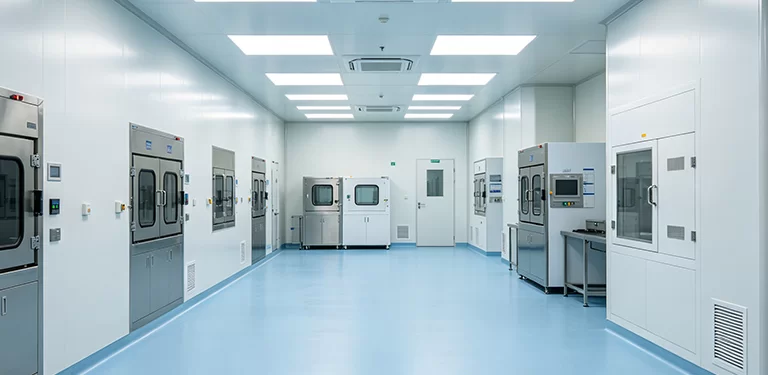
The ISO 14644-1 standard classifies cleanrooms based on the number of particles per cubic meter of air. Ranging from ISO 1 (the cleanest) to ISO 9, this classification dictates everything from HEPA filter selection to the number of air changes per hour (ACH) required for compliance.
Understanding your target ISO class is the first step in cleanroom design. Whether you are building a pharmaceutical suite or a semiconductor fab, these numbers are your non-negotiable benchmarks.
ISO 14644-1 Particle Count Standard
The following table outlines the maximum permitted particle concentrations for each class.
ISO Class | Particles ≥0.1μm | Particles ≥0.5μm | Particles ≥5.0μm | Equivalent US FED 209E |
ISO 5 | 102,000 | 3,520 | 29 | Class 100 |
ISO 6 | 1,020,000 | 35,200 | 293 | Class 1,000 |
ISO 7 | — | 352,000 | 2,930 | Class 10,000 |
ISO 8 | — | 3,520,000 | 29,300 | Class 100,000 |
Recommended Air Changes Per Hour (ACH)
To maintain these particle levels, air must be refreshed constantly. Here are the industry-standard ACH ranges:
ISO Class | Air Changes Per Hour (ACH) | Primary Filter Coverage |
ISO 5 | 240 – 480 | 35% – 70% |
ISO 6 | 150 – 240 | 25% – 35% |
ISO 7 | 60 – 150 | 15% – 25% |
ISO 8 | 20 – 60 | 5% – 15% |
Typical Industry Applications
ISO 5: Sterile pharmaceutical filling, semiconductor wafer fabrication, high-precision optics.
ISO 6: Medical device assembly, pharmaceutical preparation, aerospace components.
ISO 7: General laboratory work, pharmaceutical secondary packaging, high-end electronics.
ISO 8: Food processing packaging, plastic injection molding for medical use, bulk chemical production.
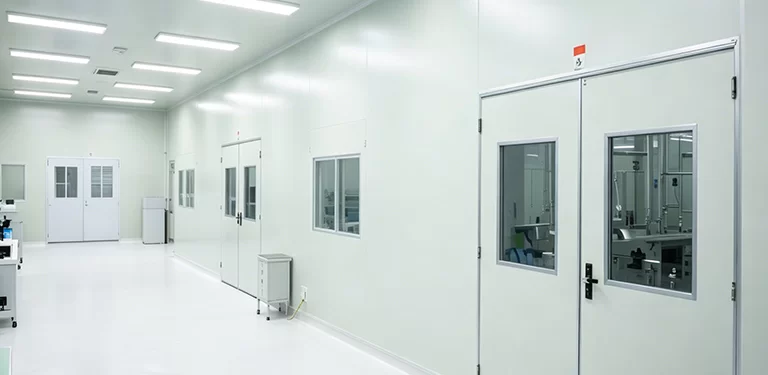
Operational States: As-Built, At-Rest, vs. Operational
It is vital to specify when the classification applies:
- As-Built: Empty room, no equipment, no people.
- At-Rest: Equipment installed and running, but no personnel.
- Operational: Full production with personnel present. (The hardest to pass).
FAQ: Frequently Asked Questions
1. What is the most common cleanroom class?
ISO 7 and ISO 8 are the most common for general industrial and pharmaceutical secondary operations.
2. Can an ISO 8 room be upgraded to ISO 7?
Yes, usually by increasing the number of FFUs and the Air Changes per Hour (ACH), provided the HVAC system can handle the load.
3. What is the difference between ISO 5 and Class 100?
They are equivalent. Class 100 is the old US Federal Standard 209E, which measured 100 particles per cubic foot. ISO 5 is the modern metric equivalent.
4. How often should a cleanroom be re-certified?
High-risk rooms (ISO 5 and cleaner) should be certified every 6 months. ISO 6-9 rooms typically require annual re-certification.
5. Does every cleanroom need an air shower?
For ISO 6 and cleaner, an air shower is highly recommended to prevent personnel from carrying surface contaminants into the room.
6. How do I measure particle counts?
Use a calibrated laser particle counter. Sampling points and volumes must follow the statistical formula provided in ISO 14644-1.
7. Is a fume hood a cleanroom?
No. A fume hood provides local protection but does not control the environment of the entire room.
8. What happens if my cleanroom fails the particle count test?
Check for HEPA filter leaks, ensure ACH is meeting the design spec, and verify that personnel are following proper gowning procedures.