KLC Class II Biosafety Cabinet: A2 vs B2 — Which One Does Your Lab Actually Need?
A Class II A2 biosafety cabinet recirculates 70% of air and exhausts 30%, making it ideal for microbiological work without volatile chemicals. In contrast, a Class II B2 cabinet exhausts 100% of its air, providing total protection when working with toxic chemicals or radionuclides.
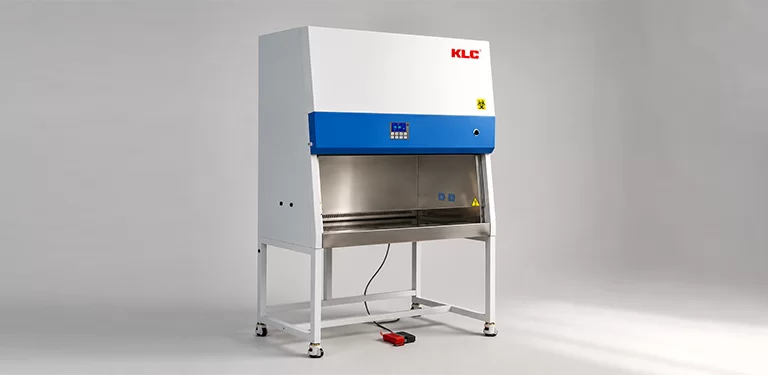
Choosing the right biosafety cabinet (BSC) is critical for laboratory safety and compliance. This guide breaks down the technical differences between the two most common types: Class II Type A2 and Type B2.
Technical Comparison: A2 vs. B2 Structure
Feature | Class II Type A2 | Class II Type B2 |
Air Recirculation | 70% Recirculated / 30% Exhausted | 0% Recirculated (100% Exhausted) |
Exhaust Requirement | Can exhaust to room or via canopy | Must be hard-ducted to external blower |
Chemical Protection | Trace amounts only (if ducted) | Excellent (volatile chemicals/radionuclides) |
Safety Fail-safe | Internal blower maintains airflow | Cabinet shuts down if external fan fails |
Energy Consumption | Lower (Internal blower only) | Higher (Requires powerful external exhaust) |
Installation Cost | Minimal | High (Ductwork + External Blower) |
Key Differences in Protection
- Airflow Mechanism: In an A2 cabinet, air is filtered by HEPA filters and recirculated within the work zone. This is sufficient for BSL-1, BSL-2, and BSL-3 pathogens.
- Total Exhaust (B2): The B2 cabinet draws all its air from the room and exhausts it entirely through a dedicated duct. This prevents any chemical vapors from building up or being recirculated onto the sample.
- Fail-Safe Operation: KLC's B2 cabinets are designed with an interlock system. If the external exhaust fan fails, the internal blower shuts down immediately to prevent positive pressure from pushing contaminated air into the lab.
Decision Tree: Which One Should You Choose?
Step 1: Are you working with volatile toxic chemicals or radionuclides?
Yes → You MUST use a Class II Type B2.
No → Go to Step 2.
Step 2: Does your facility have existing external exhaust ducting?
Yes → You can use Type A2 (with canopy) or Type B2.
No → Use Type A2 (recirculating to the room).
Step 3: Is energy efficiency a priority?
Yes → Type A2 is the superior choice.
Why Choose KLC Biosafety Cabinets?
KLC International provides high-performance Class II cabinets certified for global standards. Our cabinets feature:
- H14 HEPA Filters: 99.995% efficiency for particles down to 0.3μm.
- Real-time Airflow Monitoring: Precise sensors for inflow and downflow velocities.
- Ergonomic Design: 10° slanted front for operator comfort during long hours.
FAQ: Frequently Asked Questions
1. What is the difference between Class II A2 and B2 biosafety cabinet?
The main difference is the exhaust. A2 recirculates 70% of air, while B2 exhausts 100%. B2 is required for volatile chemicals, while A2 is for standard biological work.
2. Can I use a Class II A2 cabinet for working with volatile chemicals?
Only if it is "thimble-connected" (canopy) to an external exhaust, and only for trace amounts. For significant chemical work, a B2 is mandatory.
3. Does a B2 biosafety cabinet require external exhaust?
Yes. A B2 cabinet cannot function without a dedicated external exhaust system and a hard duct connection.
4. What BSL level does a Class II biosafety cabinet protect against?
Class II cabinets (both A2 and B2) are designed for work in Biosafety Level 1, 2, and 3 laboratories.
5. How often should biosafety cabinet HEPA filters be replaced?
Typically every 3-5 years, depending on usage and environment. KLC cabinets include a filter life indicator to alert users.
6. What certifications should a biosafety cabinet have?
Look for NSF/ANSI 49 (USA), EN 12469 (Europe), or equivalent national standards to ensure safety compliance.
7. Is a biosafety cabinet the same as a fume hood?
No. A fume hood protects the operator from chemicals but does not protect the product from contamination. A BSC protects the operator, the product, and the environment.
8. How do I validate a biosafety cabinet after installation?
You should perform field certification, including HEPA filter leak tests, airflow velocity testing, and smoke pattern visualization by a qualified technician.
Ready to upgrade your lab safety?
Explore the KLC Class II Biosafety Cabinet Series or Contact our engineers for a custom layout